POTUS 1: The One and Only
27 minutes read time
To better understand the relevancy and importance of master numbers in the current era, we must begin at the beginning. Their application to the US Presidential Election starts with the one and only POTUS 1, George Washington.
Before those of you with a distaste for history start yawning, please know that this survey offers little more than an analysis of the numerical fingerprints of a few former presidents. History buffs may condemn the lack of details, but seven presidents are covered, to be exact. Relevant issues of the day may be mentioned for context, and omission of key historical events is unavoidable. The history of the founding and growth of the United States is nuanced and complex. These details are beyond the scope of this review. For example, the role of cotton and tobacco cannot be understated. Their impact on the economy and society during this time deserves a more thorough presentation. My intention is neither to defend, correct, justify, denounce, nor judge.
While writing this blog, I have maintained objectivity without inserting my personal experience or beliefs about presidential hopefuls. Here, I briefly deviate because I am inclined to share a few thoughts, shaped by my childhood and education. Doing so sets me up for ridicule and criticism, with conscious omission an unfortunate injustice.
At this point, I remain mindful to avoid extensive exploration of several rabbit holes. Indulge me for a quick peek at five seemingly irrelevant and unrelated tangents that eventually bring us to POTUS 1. If you prefer to skip the rabbit holes CLICK HERE.
Rabbit Hole #1 – Not Your Typical Small-Town White Boy
As a child in the 1960s, in our small Kansas town, I recall one student of Mexican heritage in middle school. I did not share a classroom with Black students until high school in a different district. There was also one Asian student who was the Valedictorian. Teachers served boilerplate American history lessons with watered-down accounts of controversial and troubling events. Perhaps, they rightfully sugar-coated and spoonfed them so as not to frighten the youngsters. Save the blood and gore for older students.
The black-and-white television at home, with its three channels, echoed this naive narrative with an endless supply of Western movies and television shows. The romanticization of wagon trains, shootouts, hangings, and log cabin life on the Frontier further betrayed reality. Characters always had perfectly coiffed hair and clean clothes. There was plenty of food, and no squirting blood when shot or stabbed.
At the time, I failed to understand that the portrayal of Indians (Indigenous People) as bloodthirsty savages, Mexicans as dirty drunken thieves, and Negroes as docile servants was stereotypical and inaccurate. I was encouraged to cheer for their defeat. However, I yearned to learn more about the “bad people” who terrorized the European settlers. I would have not survived long in the Wild West, most likely being shot or hanged from a tree for befriending the enemy.
All around me, names of tribal groups like Shawnee, Seneca, Sedgwick, Sioux, Kanza, Peoria, and Pawnee were used for streets, towns, counties, and states. But where did those people go?
Thanks to National Geographic magazines, I developed an early fascination for ancient civilizations. Especially intriguing was the rise of Neolithic people who abandoned a hunter-gatherer lifestyle. Instead, they chose to grow their own food and build settlements that blossomed into civilizations and empires.
I was also intrigued by the presence of indigenous communities still in existence around the world. Some maintained an aboriginal lifestyle while others embraced the comforts of modern life. I studied anthropology and archaeology as an undergraduate. My focus was on ancient pre-Columbian Latin America. I confess a tendency to endless discussion enticed by this particular rabbit hole.
Some of my archaeological fieldwork involved sites associated with the Poverty Point culture. These sites date to 3,500 years ago along the lower Mississippi River and surrounding Gulf Coast area. This was long before the familiar tribal names like Apache, Cherokee, or Navajo. The area is notable for a large bird-shaped earthwork. It has concentric rings for housing and crops. There are also unusual fired clay objects, deemed Poverty Point Objects, with a wide variety of incisions and designs. This culture was nearly contemporaneous with the Olmec civilization that popped up on the Yucatán Peninsula, directly south across the Gulf of Mexico.
Rabbit Hole #2 – The Emergence of Civilizations
A handful of pristine civilizations rose around the world. These include Mesopotamia, Sumeria, Egypt, Indus Valley, and China. Two of these civilizations appeared in the Western Hemisphere, located in Mesoamerica and the Andes. The transition from hunter-gatherers to settlements and agriculture is thought to have begun 5,000-6,000 years ago. I find it interesting that the pre-Classic Maya period and Olmec civilization arose during the same time as the early Zhou and Shang (Yin) Dynasties pre-China. A topic of much speculation, the huge Olmec stone heads bear an uncanny Chinese appearance.

The birth of Imperial China with Emperor Ying Zheng and the Qin Dynasty (221-206 BC) followed by the Han Dynasty (206 BC – 220 CE) coincided with the rise of the Maya Classic period in Mesoamerica. The Greek Empire had come and gone and the rise of the Roman Empire was yet to come. The point being, that new civilizations were popping up around the world.
Vikings such as Lief Erickson visited the northern continent perhaps 500 years before the wave of European explorers Colón, Magellan, Dias, DeGama, Balboa, Cortés, Vespucci, Pizarro, Cartier, and Champlain. Had they not come, Chinese explorers would have eventually arrived from the great sea to the west. It remains interesting to conjecture how Latin America and North America would look today if the Western Hemisphere civilizations had developed uninterrupted.
Rabbit Hole #3 – Flat Earth Fanatics
What if European explorers never perfected sailing across the Atlantic? What if those Flat-Earthers were right and all of their ships ended up on the ocean floor? With no roundtrip sailors reporting on what lay beyond, would potential explorers consider exploring in a different direction, never knowing of the New World? Doubtful.
With monumental architecture, farming, irrigation systems, road networks, mathematics, astronomy, art, and some with elaborate writing and calendar systems, what technologies might these societies have eventually developed? The familiar civilizations of the Aztecs and Inca may seem like ancient history to some. However, they didn’t come along until a few hundred years before the arrival of the Spanish. The Aztec Empire was already in decline. Who can say if the Inca Empire would have soon faded away like the ones before?
Sitting atop Machu Picchu, the magnificent 15th-century citadel hidden away in southern Peru, causes one to conjecture. See what I mean about rabbit holes?
Rabbit Hole #4 – Birthing a Nation is Messy Business
The ancient empires of Persia, Rome, Greece, Egypt, and Sumeria subjugated neighbors. They exploited resources and imprisoned and enslaved their neighbors. Similarly, those in the opposite hemisphere engaged in their share of brutality against each other long before the Europeans arrived. Such treatment of fellow humans is not justified. Yet, it seems to be a fact of life during the expansion of civilizations. Humans are a peace-loving yet warlike species.
Plenty of damage occurred throughout South America and Mesoamerica for three centuries before George Washington arrived on the scene. Well-established civilizations with strong defenses in the south were toppled, and less advanced people in the north stood little chance. A thousand years before the arrival of Europeans, the US Southwest experienced a boom in population. It developed large-scale agriculture and organized settlements. They created complex ceremonial centers, some with amazing astrological alignments. Had their ingenuities spread across the continent and advanced, the Europeans might have encountered a more formidable force. But that did not happen.
Then there is the matter of those nasty microbes. No knowledge existed of how the lack of immunity to diseases would impact indigenous populations. These communities were already fractured by fighting among neighboring groups for hunting territory. They also fought for women outside their clan for breeding, dominance, and control. Many tribal nations and groups aligned and traded with British, French, and Spanish forces to gain an edge over their enemies.
Jesuits, Franciscans, and Dominicans established missions in Florida, Texas, Baja Mexico, and California. They cleared a path through the wilderness with their crosses and rosaries. Their goal was to convert native populations to Christianity. They wanted to pacify the territory for settlements. Their aim was to indoctrinate the people into Spanish culture and solidify Spanish control.
When Washington came to power as POTUS 1, several behaviors were considered acceptable for centuries. These included invading, plundering for resources, displacing native populations, and slavery. The concept of slavery took many forms, not limited to Black Africans. A banking and economic system saw people of Irish, Mexican, and Chinese heritage enter into indentured servitude as a way to pay off debt. When born into a world with set beliefs and moral attitudes, change comes slowly and with great difficulty. Indeed, in the early days, only white male landowners were allowed to vote. In some places, the age of consent was 10 years old. Different times, different values. The continent was already swarming with colonists. French, British, and Spanish forces were seeking to carve out their share of the pie. Washington had quite a mess to clean up.
Rabbit Hole #5 – This Land is Your Land, This Land is My Land
Some Americans assert we are living on stolen land, and that colonization was intentionally malicious and evil. This view offers a history equally simplistic and inaccurate as the candy-coated version. Yes, bad things happened, but many good things happened, too. The truth likely lies somewhere in the middle. Before the time of international rules of war, the unwritten rule was well known. If you cannot defend your land, resources, assets, and people, they are likely to be taken away from you by force. That remains true today when our personal belongings, food, and home must be secured. Vehicles, women, and children require protection with a variety of security measures, guard dogs, fences, alarms, cameras, guns, and safes. Even in modern times, a country needs strong borders. It must have a national defense against adversaries who would seek to invade or exploit. Otherwise, it is wise to develop powerful allies.
Once word got out regarding an entirely new continent to the west, people seeking a better life were willing to take the perilous journey, despite the risks and uncertainty. Another facet of our quirky human nature.
Shaped by who controls the narrative, any retelling of historical events often omits unsavory facts. The international slave trade and domestic expansion of slavery were among these unsavory facts. They influenced the political views of the Founding Fathers and divided the nation from the get-go. The acquisition of land for settlement expansion caused a complex network of Indigenous Peoples to be displaced across the continent.
We can’t ignore this sordid past, nor should we promote it as the primary or only narrative. I am proud to live in the country that finally put an end to the madness. This nation serves as a beacon of hope and freedom. Although injustices occurred in the distant past, and not-so-distant past, neither I nor anyone I know was involved in them. I do not try to compensate or feel responsible for the sins of my ancestors. Instead, I have intentionally sought out and befriended people from all ethnicities. I have met people from nearly every country in South America and the Caribbean. Some Black friends have children who chose to seek citizenship in Africa and are quite content. Despite challenges faced by some Black communities in the United States, most prefer to stay. Very few Indigenous People I have met express a desire for the old way of life. One commonality I find is that, beyond ethnicity or racial identity, most people seem proud to be American.
The USA may be far from perfect, but greater success, prosperity, and political power are enjoyed among all ethnicities. If America was truly such a horrible place, we would see mass migrations outta here and millions of people around the world would not want to live here.
No more rabbit holes – Where were we?
Instead of attempting a comprehensive review of the past 300 years, the handful of milestones highlighted here serve as checkpoints along the highway of US history. You may overlay this template onto whatever version of history you prefer. This may gauge if the country needed a course adjustment. It also indicates whether the country was on the right path despite what seemed like endless turmoil, chaos, war, and struggle.
What clues appear that might serve as a warning sign or wake-up call? More specifically, we analyze the numerical fingerprints of select US presidents. This analysis helps us determine if the best person for the job of POTUS appeared at the right time.
To help navigate this critical time, start the journey with POTUS 1. Discover patterns that emerge, and perhaps a secret code — a POTUS Code.
The first president or leader of any country embodies the characteristics of the number one, independence and leadership. There can be only one number one. One is the first, a leader who stands alone. It is the first number with which we start counting. Without the number 1, there would be no beginnings.
George Washington knew about personal development and character building. He was one of several presidents who were members of the fraternal order known as Freemasonry. Benjamin Franklin was one of the most remarkable figures in early American history. He was initiated into Freemasonry when Washington was an infant. Some members of Washington’s Cabinet practiced Freemasonry. This included James Monroe and Alexander Hamilton. Other succeeding presidents also joined the order. These will be noted as we move ahead in time.
Misinformed claims often attribute sinister intentions to the Freemasons as a secretive cult. However, they were simply one of many fraternal societies common in British society at the time. These societies proliferated as people migrated to America. Local Freemasons performed ceremonies and rituals during the laying of cornerstones of the White House and Washington Monument. Masonic symbols were also incorporated into the layout and design of the District of Columbia.
The organization of Freemasonry has its roots in medieval England and Scotland of the 1400s. It developed in connection with stonemasons and the craft of building and construction. Common tools of the trade became symbols of the movement: the square and compass, plumb line, and trowel. As in stone masonry, Freemasonry recognizes distinct levels based on skill and experience from apprentice to master.
The principles applied to cutting and placing stones for constructing buildings are mirrored in building one’s life. This begins from the foundation up. While the use of numbers in precise measurements is essential for proper construction, principles of sacred geometry also played a role. These principles were considered in the formation of a new country. Washington’s interest in Freemasonry likely made him aware of the esoteric significance of numbers. He likely understood their unique ability to convey information. When the Master Mason passes the tools of the trade to the next generation, the apprentice must aspire to mastery.
Washington was greatly admired by most of his contemporaries, such as Thomas Jefferson, John Adams, James Madison, and Benjamin Franklin. From his early military activities, he gained a reputation for integrity and courage. He fought for the British in the French and Indian War in the Ohio Valley. Some campaigns were more successful than others. Having fought for the British, he was aware of their weaknesses.
As a result, the May 1775 Continental Congress appointed Washington as a General. Despite having no army, he organized a fighting force in the American Revolution. His Freemason buddies, such as Franklin, contributed behind the scenes. They played a key role in organizing spy networks that utilized secret codes to subvert the British. Those codes involved converting a long list of words into numbers.
Washington was unanimously elected as President after ratification of the Constitution.
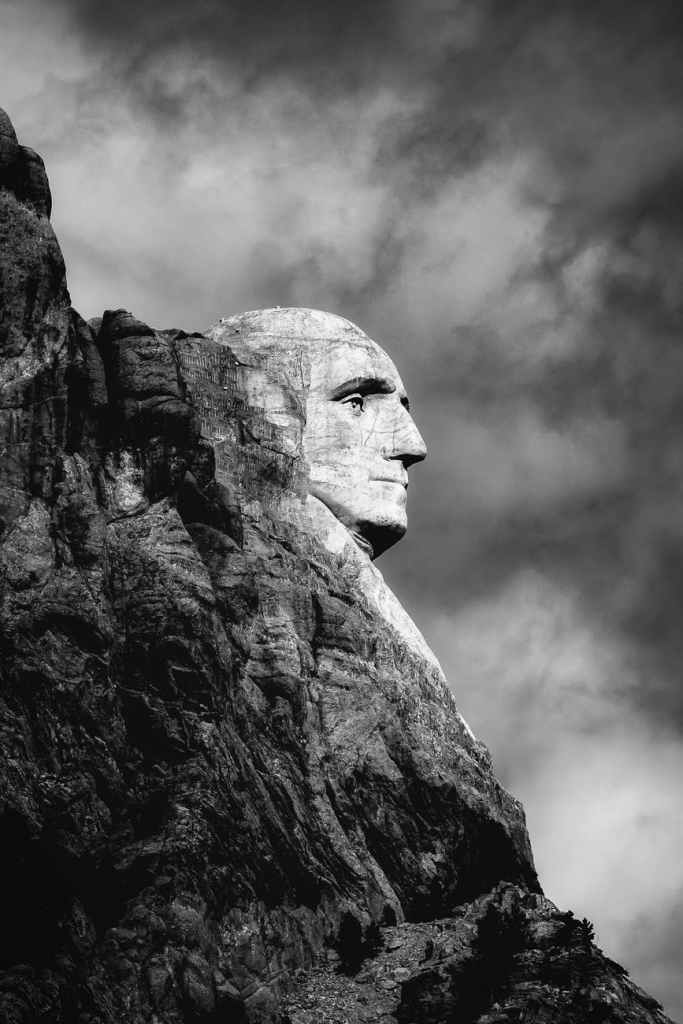
POTUS 1 George Washington (1789-1797) Two-term Independent. Freemason. Military Service: Lt. Col. in early battles of the French and Indian War. Rose through the ranks of the Virginia militia eventually commander of all Virginia troops. When the Revolutionary War started, he was appointed as Major General and Commander-in-Chief of the Continental Army from 1775 to 1783. Slaveholder who banned slavery north of the Ohio River, and advocated for the abolition of slavery. Eleven states joined the Union during Washington’s first term, and five in his second term, with a balance of eight slave states and eight free states. For all of the POTUS to follow, maintaining this delicate balance was crucial. Washington is one of four US Presidents featured on Mount Rushmore and his likeness is featured on the twenty-five cent coin (quarter) and the $1 bill.
What does Washington’s numerical fingerprint reveal about his level of mastery?
George Washington
| G | E | O | R | G | E | W | A | S | H | I | N | G | T | O | N | ||||||||||||||||||
| 7 | 5 | 15 | 18 | 7 | 5 | 23 | 1 | 19 | 8 | 9 | 14 | 7 | 20 | 15 | 14 | ||||||||||||||||||
| 7 | 5 | 6 | 9 | 7 | 5 | 5 | 1 | 1 | 8 | 9 | 5 | 7 | 2 | 6 | 5 |
- 11+11+1+7+3+1 = 34/7
- 11+11+1731 = 1753 = 1+7+5+3 = 16/7
- 1731 = 12/3
- 11+11+12 = 34/7
- 11+11+3 = 25/7
- 2+2+3 = 7
- 2+22+1+7+3+2 = 37/10/1
- 2+22+1732 = 1756 = 1+7+5+6 = 19/10/1
- 1732 = 13/4
- 2+22+13 = 37/10/1
- 2+4+13 = 19/10/1
- 2+4+4 = 10/1
- BIRTH DATE = 7 and 1
- VOWELS = 50/5 (full); 32/5 (reduced)
- CONSONANTS = 137/11 (full); 56/11 (reduced)
- FIRST NAME = 57/12/3 (full); 39/12/3 (reduced)
- MIDDLE NAME = none
- LAST NAME = 130/4 (full); 49/13/4 (reduced)
- FULL NAME (16 letters) = 187/16/7 (full); 16/7 (reduced)
- MOST COMMON NUMBERS = four 5s, three 7s, two each of 1, 6, 9
- LEAST COMMON OR MISSING NUMBERS = one each of 2 and 8, with 3s and 4s missing
When we look at Washington’s birthday very interesting things occur. George was born during the time when Britain still used the Julian calendar and recorded his birth on February 11, 1731 (11-11-1731). So, what happened? At the time, the first day of the year fell on March 25, causing February 11 to fall within the eleventh month of the year, not the second month. Interestingly, whether you add this original date of birth with February as the second month or the eleventh month, either way, the result is a 7.
Upon conversion to the Gregorian calendar in 1752, January 1 became the first day of the year, and birth dates were moved ahead 11 days. An extra adjustment occurred for those born between January 1 and March 25, adding a year. In the process, Washington’s date of birth changed to February 22, 1732 (2-22-1732), with February now the second month of the year, not the eleventh. The day changed from the 11th to the 22nd and the year changed from 1731 to 1732. This changes the birth date total from 7, the number for a dignified educator to 1, the number for a confident leader. Here are some resources about these calendar changes:
http://libguides.ctstatelibrary.org/hg/colonialresearch/calendar
https://www.timeanddate.com/calendar/julian-gregorian-switch.html
There are two master numbers in the original date of birth and one master number in the adjusted date. These were found in the nation’s first leader. This is a prime example of master number synchronicity. It shows how it can be used to recognize people, even as infants, with the potential to become great leaders. According to most accounts, George was a tender 22 years old when he fought in the French and Indian Wars. He was 44 years old when the American Revolution began. POTUS 1 celebrated his 65th (6+5=11) birthday during his final year as POTUS. He celebrated his 66th birthday before his death at the age of 67.
The other part of a numerical fingerprint involves the substitution of numbers for the letters in a name. This is akin to what Freemasons did with their secret codes and spy networks. With George Washington, the most common numbers appear as four 5s (E, N, W), recognized as the number of freedom and change; three 7s (G); and two 1s (A, S), 6s (Os), and 9s (I, R). Some of these are found elsewhere as VOWELS (5), FULL NAME (7), ORIGINAL BIRTH DATE (7), and CONVERTED BIRTH DATE (1).
The least common numbers show up as one each of 2 (T) and 8 (H), with 3s and 4s completely missing. These deficient numbers are found elsewhere as ORIGINAL BIRTH YEAR (3), CONVERTED BIRTH YEAR (4), ORIGINAL BIRTH MONTH (11/2), CONVERTED BIRTH MONTH (2), ORIGINAL BIRTH DAY (11/2), CONVERTED BIRTH MONTH (22/4). FIRST NAME (3), and LAST NAME (4). All of these weak numbers, except for 8, are greatly enhanced.
Master numbers found in the name include CONSONANTS (11). Another interesting thing occurs if you dig deeper. Determining the FULL NAME total can be arrived at by adding consonants and vowels, or first name and last name. In this case, the original reduced value of VOWELS (32) and the original reduced value of CONSONANTS (56) combine to equal 88. Likewise, the original reduced value for FIRST NAME (39) and the original reduced value for LAST NAME (49) combine to equal 88. This hidden master number emphasizes his depth of mastery and compensates for the otherwise missing 8s.
Learn more about the numerology of the word master in my post HOCUS POCUS POTUS: Identifying the Numerical Fingerprint.
Washington was inaugurated at age 57. He was in office for two four-year terms from April 30, 1789, to March 4, 1797. A true master set the new country on course during a complicated time in history. This person is worthy of being forever known as POTUS 1. With the passage of centuries, remnants of Washington stay firmly in our consciousness and throughout society. Washington stood out among other world leaders as someone who relinquished power, rather than clinging to it. He gave up military power after the American Revolution. He also relinquished power at the end of his second term as President.
George Washington forged more than a framework for a new nation, he designed a road map into the future. He could only hope that his POTUS successors possess the knowledge, wisdom, and skills to interpret the map and navigate accordingly.
More importantly, would the citizenry through successive generations not fall asleep at the wheel, and pay attention to the signs? Would they learn the secret code to identify presidential potential?
POTUS 2 John Adams (1797-1801) One-term Federalist. Vice president to POTUS 1. Not a slaveholder, not a Freemason. He was a leader in the American Revolution and traveled extensively on diplomatic missions to Europe. He chose to remain neutral in the French Revolutionary War, upsetting many of his contemporaries, especially his successor.
POTUS 3 Thomas Jefferson (1801-1809) Two-term Democratic-Republican. Military Service: Colonel in Virginia Militia during the American Revolution. Secretary of State to POTUS 1. Nearly won the election for POTUS 2. Although an opponent of POTUS 2, became his vice president. Opposed strong central government and encouraged the rights of states. Acquired the Louisiana Territory from Napolean in 1803 for $15 million, more than 800,000 square miles of land west of the Mississippi River. Within a year of this deal, POTUS 3 sent Lewis and Clark on their historical expedition to discover a northwest passage to the West Coast. That expedition was successful due to assistance from native people they met along the way. Ohio was admitted as the 17th state, a free state. Although a slaveholder, POTUS 3 oversaw the abolition of the international slave trade. Jefferson is one of four US Presidents on Mount Rushmore and his likeness is featured on the five-cent coin (nickel). Jefferson often appears on the list of Top 10 most influential POTUS.
POTUS 4 James Madison (1809-1817) Two-term Democratic-Republican. Military Service: Colonel in Virgina Militia. Secretary of State to POTUS 3. War of 1812 with British forces laying siege to the US Capitol and White House. Louisiana was admitted as the 18th state and was a slave state. Indiana was admitted as the 19th state and was free. Although a slaveholder, POTUS 4 condemned slavery and the international slave trade; opposed the restriction of domestic expansion of slavery. Madison’s likeness was featured on the $5000 bill, no longer in circulation.
Inspired by the United States’ break from British rule, countries throughout the Americas gained independence from the Spanish Empire and Portuguese Empire, during the administrations of POTUS 3 and POTUS 4.
POTUS 5 James Monroe (1817-1825) Two-term Democratic-Republican. Freemason. Military Service: Major in Continental Army. Governor of Virginia. Secretary of State to POTUS 4. Instrumental in completing the Louisiana Purchase. Secured the purchase of Florida from Spain for $5 million with the help of his Secretary of State, John Quincy Adams. Known for the Monroe Doctrine, warning European powers against interfering in the Western hemisphere. Five states were admitted during this administration: Mississippi (20th), Illinois (21st), Alabama (22nd), Maine (23rd), and Missouri (24th), three slave and two free. Although a slaveholder, POTUS 5 resolved the issue of Missouri entering the Union as a slave state. He barred slavery north and west of Missouri. Arranged for freed slaves to go to Liberia, the capital of which was named Monrovia in his honor.
POTUS 6 John Quincy Adams (1825-1829) One-term Democratic-Republican and National Republican. Son of POTUS 2. US Representative and Senator from Massachusetts, Secretary of State to POTUS 5. Not a slaveholder, not a Freemason. First president to be photographed, several years after leaving office.
POTUS 7 Andrew Jackson (1829-1837) Two-term Democratic. Freemason. Military Service: Major General during War of 1812; U.S. Volunteer Army and Tennessee Militia. Considered a hero for defeating the British at New Orleans. US Representative and Senator from Tennessee. Slaveholder. Oversaw the Indian Removal Act that relocated tens of thousands of Native Americans. Before POTUS 7, only landowners could vote. Then the process changed to include all white men, regardless of socioeconomic status. Arkansas and Michigan were admitted as the 25th and 26th states, one slave and one free,. Jackson’s likeness is featured on the $20 bill, although set to be replaced with Harriet Tubman in the late 2020s. Jackson often makes the list of Top 10 most influential presidents.
POTUS 8 Martin Van Buren (1837-1841) One-term Democratic. US Senator from New York, Governor of New York, Secretary of State and vice president to POTUS 7. Slaveholder to one slave who escaped but was not pursued. Opposed domestic expansion of slavery but not its abolition. Blocked the annexation of Texas to avoid adding more slave territory and inciting war with Mexico. First president to be born in the United States.
POTUS 9 William Henry Harrison (1841) One-term Whig. Military Service: major general for Kentucky Militia during the War of 1812. First Governor of the Indiana Territory. US Representative and Senator from Ohio. Slaveholder who lobbied Congress to legalize slavery in Indiana. The first POTUS to die in office. Shortest presidential terms of 31 days.
The year 1841 saw three Presidents: POTUS 8 leaving office, POTUS 9 dying within a month of assuming office, and his VP succeeding to the presidency as POTUS 10.
SUMMARY OF CYCLE ONE
| 1 | 2 | 3 | 4 | 5 | 6 | 7 | 8 | 9D |
- Master Number: no specific master number POTUS appears although POTUS 1 exhibits a notable numerical fingerprint
- Freemasons: 3. POTUS 1, POTUS 5, POTUS 7
- Slaveholders: 7. POTUS 1, POTUS 3, POTUS 4, POTUS 5, POTUS 7, POTUS 8, POTUS 9 Although slaveholders, some while in office, most opposed the international slave trade and domestic expansion of slavery.
- Death while in office: 1. POTUS 9
- States added: 26. In estimated chronological order: POTUS 1: DE, PA, NJ, GA, CT, MA, MD, SC, NH, VA, NY, NC, RI, VT, KY, TN; POTUS 3: OH; POTUS 4: LA, IN; POTUS 5: MS, IL, AL, ME, MO; POTUS 6: AR, MI
- One-term: 4. One Federalist, One Democratic-Republican, One Democratic, One Whig. Two-term: 5. One Independent, Three Democratic-Republican, and One Democratic.
- Duration: 52 years. After POTUS 1, it took 44 years to finish this cycle. This cycle concluded 20 years sooner than it would have if each POTUS served two full terms, ushering in Cycle Two in an accelerated time frame.
- Inventions and Innovations: Cotton gin, Jefferson wheel cipher, sewing machine, steam shovel, Morse Code and telegraph, baseball. Military branches of the Continental Army, Navy, and Marine Corps began in 1775; Coast Guard 1790. Major educational institutions were already well-established in America, with Harvard University founded a century before Washington was born. College of William & Mary, Princeton, Yale, Columbia, and the University of Pennsylvania opened their doors before Washington became president. Many of these were funded by the generosity of wealthy businessmen.
- Population Centers: During this cycle, the largest cities greatly increased in population (estimated): New York City from 33,000 to 312,000, Baltimore from 13,000 to 102,000, New Orleans grew to 100,000, Philadelphia from 28,000 to 94,000, Boston from 18,000 to 93,000, Cincinnati grew to 46,000, Brooklyn grew to 36,000, Albany to 34,000, and Charleston from 16,000 to 30,000
For a look at humanity and civilizations, and the history of the USA from a variety of perspectives:
- Sapiens: A Brief History of Humankind by Yuval Noah Harari (HarperCollins, 2015)
- These Truths: A History of the United States by Jill Lepore (W. W. Norton & Company, 2018)
- An Indigenous Peoples’ History of the United States by Roxanne Dunbar-Ortiz (Beacon Press, 2014)
- The Slave Trade by Hugh Thomas (Simon & Schuster, 1997)
UP NEXT >> POTUS 11: OK OK
*Uncredited images created with WordPress AI Image Generator
This is part of a series entitled POTUS CODE: Election-Year Guide to Picking a President by the Numbers
My reviews of the numerical fingerprints remain nonpartisan, unbiased, without regard to policies or personality. I could provide an analysis of what I think it means, but wish to avoid appearing critical, judgmental, or showing favoritism to influence one way or another. For your convenience, refer to common interpretations below, or seek out other sources. You may cross-reference any numbers you consider significant and arrive at your own conclusions.
For Reference
- BIRTH DATE = Life Path to reveal opportunities, challenges, lessons
- VOWELS = Heart’s Desire
- CONSONANTS = Authentic Self
- FIRST NAME = Personality
- LAST NAME = Traits
- FULL NAME = Destiny or Expression
- MOST COMMON NUMBERS = Strengths
- LEAST COMMON OR MISSING NUMBERS = Weaknesses
| NUMBER | INTERPRETATION |
|---|---|
| 1 | confident leader |
| 2 | cooperative diplomat |
| 3 | expressive speaker |
| 4 | honest worker |
| 5 | freedom and change |
| 6 | responsible humanitarian |
| 7 | dignified educator |
| 8 | ambitious executive |
| 9 | compassionate philanthropist |
| MASTER NUMBER | INTERPRETATION |
|---|---|
| 11 | Signifies mastery over the physical plane, illumination, responsibility, mysticism, empathy, inspiration, psychic abilities, and spiritual insight. Some numerologists consider 11 to possess only negative characteristics, such as offensiveness and deviance. Chinese numerology relates 11 to the Tao, or the way of heaven. Negative characteristics commonly attributed to 11 include: deception, delusion, instability, dishonesty, and confusion. Note that these numbers reduce to 11: 29 and 92, 38 and 83, 47 and 74, 56 and 65. |
| 22 | Considered the “Master Architect” representing material mastery and the ability to manifest abstract ideas, innovation, intuition, detachment and objectivity, power, philanthropy and altruism, originality and invention, leadership and achievement. Negative characteristics commonly attributed to 22 include: fanaticism, perversity, immorality and lawlessness, insensitivity, rebellion, cynicism, malevolence, destruction, cruelty, tyranny. |
| 33 | Represents compassionate giving and selfless service to humanity, gentleness, and kindness. Negative traits include: callous, inhumane, selfish, malicious. |
| 44 | In numerology, the number 44 often represents a confident leader, efficient, energetic, and ambitious. Negatively it can manifest as intolerance, abuse, self-destruction, and ignorance. |
| 55 | Intelligent, skillful, talented, and active. Negative characteristics commonly attributed to 55 include: foolish and slovenly. |
| 66 | Cheerful and humorous. Negative: hateful, jealous, impatient. |
| 77 | Charming, adventurous, clever, adaptable. Negative: perverse, self-indulgent. |
| 88 | Successful, highly spiritual. Negative: dishonest, sarcastic, evil, ulterior motives. |
| 99 | Generous, fulfilled, compassionate, loving, joyful. Negative: possessive, immoral, deceptive, unfulfilled, aimless. |
For more information about master numbers and the numerical fingerprint of the word master see post HOCUS POCUS POTUS: Identifying the Numerical Fingerprint
A-1, B-2, C-3, D-4, E-5, F-6, G-7, H-8, I-9, J-10, K-11, L-12, M-13, N-14, O-15, P-16, Q-17, R-18, S-19, T-20, U-21, V-22, W-23, X-24, Y-25, Z-26
- 1= A J S
- 2 = B K T
- 3 = C L U
- 4 = D M V
- 5 = E N W
- 6 = F O X
- 7 = G P Y
- 8 = H Q Z
- 9 = I R
 POTUS CODE
Interesting analysis Skot; I found it quite informative.
Taking a much broader overview, I wonder how many Americans would acknowledge 350 m Americans can’t get along anymore? It seems clear to me.
Hows about a no fault divorce? I’ve studied a lot of plans for peaceful separation of states in the US.
Recent bloodless reorganizations of national entities have succeeded (reuniting Germany, dissolving the USSR, forming the EU, Brexit.)
Where’s our good old-fashioned American ingenuity? If it takes a constitutional amendment, are we concerned about altering that sacred cow? Our 1st Amendment isn’t allowing free speech right now. You can’t buy a gun, or carry the ones you own, and a mandatory buy-back is coming this month, but YAY 2nd amendment! Abortion is “constitutional.” We impeach our political enemies or attempt to remove them using the 14th or 25th amendment. You have freedom of assembly unless you want to attend THAT ralley.
How’s that sacred cow workin’ out for ya?
Let’s work on a secessation plan so the fighting can stop.
LikeLiked by 1 person
Eileen, I appreciate you taking time to leave such a thoughtful comment. It does seem that this is a country inhabited by people with opposite ideologies, values, priorities, and goals for the future. Your suggestion of a bloodless divorce, with real-life examples, offers hope.
LikeLike
I’m full of hope for the future!❤
LikeLiked by 1 person